
Court-appointed communication tools change the nature of family communication. What might once have been a private text, a frustrated phone call, or a moment of emotional misunderstanding becomes a permanent written record. In that setting, communication is no longer just communication. It becomes documentation. It becomes evidence. It becomes something that can be reviewed by attorneys, evaluators, parenting coordinators, guardian ad litem, therapists, judges, and experts who may never meet the parent in ordinary life but who will form impressions from the parent’s written words.
That shift matters.
A parent using a court-appointed platform is not merely trying to be understood by the other parent. The parent is also writing for an unseen audience. Every sentence may later be read outside the emotional context in which it was written. A sarcastic remark may be called hostility. A long explanation may be called manipulation. A defensive response may be called escalation. Repeated requests for information may be reframed as harassment. Even efforts to explain pain, fear, or frustration may be interpreted not as human emotion but as evidence of conflict orientation, poor boundaries, instability, or inability to coparent.
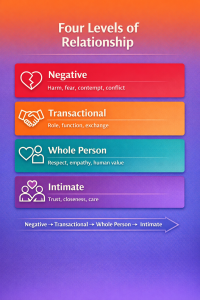
This is one reason the attached framework is useful. It identifies four levels of relationship: negative, transactional, whole person, and intimate. In ordinary human life, all four may appear at different times. But in court-appointed communication systems, the safest level is usually transactional, sometimes softened by limited whole person language. The most dangerous level is negative, because court professionals often read anger, contempt, accusation, and sarcasm as indicators of poor judgment or emotional dysregulation. The least useful level in monitored family-court communication is often intimate, because trust, closeness, and emotional depth are not the functional purpose of the tool.
In other words, parents are often punished not only for what they say, but for the level of relationship their language reflects.
1. Negative communication is easiest to weaponize
Negative communication includes blame, contempt, emotional attacks, mind-reading, threats, score-settling, and repeated references to past harm. In real life, negative communication may be understandable. Separation, betrayal, custody conflict, financial stress, and fear over children can produce intense emotions. But in a court-appointed system, negative language is unusually vulnerable to misuse.
A parent who says, “You never care about the children unless it benefits you,” may believe they are describing a pattern. But what gets recorded is not the pattern. What gets recorded is the accusation. A parent who says, “I’m tired of your abuse,” may be describing lived experience. But what may later be highlighted is the emotionally charged label. A parent who says, “You always do this” or “You are lying again” may feel justified, but the written message can be reframed as combative, inflammatory, or proof that the parent fuels conflict.
The danger is not only that these statements look bad. The deeper danger is that they distract from facts. Once a parent moves into negative language, the content is easier to ignore, and the tone becomes the story.
2. Transactional communication is the safest default
Transactional communication focuses on role, function, logistics, and specific requests. It reduces ambiguity. It avoids emotional overexposure. It stays close to observable facts. In court-appointed tools, this is usually the safest zone.
Transactional communication says:
- “Ashley’s appointment is Thursday at 2:00 p.m.”
- “Please confirm whether you will attend.”
- “I will send the school form tonight.”
- “The exchange will occur at 5:00 p.m. at the usual location.”
- “Please upload the receipt when available.”
This kind of language is not cold. It is disciplined. It signals organization, restraint, and focus on the child’s needs rather than adult grievance. It also denies others the opportunity to reframe the parent’s message as threatening or emotionally volatile.
Transactional communication is especially important when the other parent is provocative. A monitored platform often rewards the parent who appears most concise, least reactive, and most predictable. That does not mean the less emotional parent is always more truthful. It means the system often reads neutral structure as competence.
3. Whole-person communication can be used carefully
Whole-person communication includes respect, empathy, and recognition of the other person’s humanity. In family court, a limited amount of this can help. It can reduce the appearance of rigidity or hostility. But it should be used sparingly and strategically.
Examples include:
- “Thank you for confirming.”
- “I understand this schedule is difficult.”
- “I appreciate the update.”
- “I want to keep this focused on what works best for Ashley.”
- “I understand we may see this differently.”
This kind of language can show maturity without inviting emotional entanglement. It helps a parent avoid looking robotic or punitive. But it should not become overexplaining, emotional pleading, or self-disclosure. The goal is not reconciliation. The goal is credibility.
4. Intimate language is usually misplaced in court-monitored tools
Intimate communication relies on trust, vulnerability, emotional closeness, and shared meaning. That may belong in a healthy personal relationship. It usually does not belong in court-appointed communication systems.
Statements like:
- “I thought you of all people would understand”
- “I still care about our family”
- “This hurts me more than you know”
- “I need you to hear me as a person”
may be deeply human, but they often perform badly in a monitored legal context. They invite reinterpretation. They create openings for emotional reversal. They can be used to portray a parent as needy, unstable, attached, manipulative, or unable to maintain appropriate boundaries.
In court-appointed tools, intimate language often increases vulnerability without increasing protection.
5. The practical rule: write for the record, not for release
The parent’s real audience is often not the other parent. It is the future reader.
That means each message should do four things:
- stay factual,
- stay child-focused,
- make one clear request or record one clear fact,
- and avoid emotional language that can swallow the point.
A good message should be boring to an evaluator and useful to a judge.
The safest communication style is not silence and not surrender. It is disciplined clarity. A parent does not need to become emotionless. But the parent does need to understand that in court-appointed systems, language can be detached from context and used as character evidence. The more a parent writes in a transactional mode, with limited whole person respect, the harder it becomes to weaponize the message.
The core lesson is simple: in family-court communication tools, the parent who feels most compelled to explain is often the parent most at risk. The answer is not to say nothing. The answer is to say less, say it clearly, and say it at the right level.
Save yourself a lot of time and money don't fall into the trap.
Peace to all,
Elena


Leave A Comment